Tuesday, January 17, 2017

Building Trust Inside Your Team- http://www.mindtools.com/pages/article/building-trust-team.htm, http://www.mindtools.com/pages/article/working-virtual-team.htm, http://www.mindtools.com/pages/article/improving-group-dynamics.htm

Building Trust Inside Your Team

Creating a Strong, Cohesive Group

Team holding hands.
Build trust between team members.
© iStockphoto/skynesher
 You may be deceived if you trust too much, but you will live in torment if you don't trust enough.– Frank Crane, American minister and author
Have you ever managed people who didn't trust one another? If you have, then you'll know how challenging and draining this can be.
A team without trust isn't really a team: it's just a group of individuals, working together, often making disappointing progress. They may not share information, they might battle over rights and responsibilities, and they may not cooperate with one another. It doesn't matter how capable or talented your people are, they may never reach their full potential if trust isn't present.
However, when trust is in place, each individual in the team becomes stronger, because he or she is part of an effective, cohesive group. When people trust one another, the group can achieve truly meaningful goals.
So how can you, as a leader, help your team build the trust that it needs to flourish? In this article we'll look at the issue of trust within teams, why it's important, and what you can do to build it.

The Importance of Trust

One definition describes trust as a "reliance on the character, ability, strength, or truth of someone or something."
Think about that definition for a moment. Trust means that you rely on someone else to do the right thing. You believe in the person's integrity and strength, to the extent that you're able to put yourself on the line, at some risk to yourself.
Trust is essential to an effective team, because it provides a sense of safety. When your team members feel safe with each other, they feel comfortable to open up, take appropriate risks, and expose vulnerabilities.
Without trust there's less innovation, collaboration, creative thinking, and productivity, and people spend their time protecting themselves and their interests – this is time that should be spent helping the group attain its goals.
Trust is also essential for knowledge sharing. A study published in the "Journal of Knowledge Management" found that trust was a key element in a team's knowledge acquisition. Put simply, if your team members trust one another, they're far more likely to share knowledge, and communicate openly.

Strategies for Building Trust

As a leader, what can you do to create a culture of trust within your team?

1. Lead by Example

If you want to build trust within your team, then lead by example  , and show your people that you trust others. This means trusting your team, your colleagues, and your boss. Never forget that your team members are always watching and taking cues from you – take the opportunity to show them what trust in others really looks like.

2. Communicate Openly

Open communication is essential for building trust. You need to get everyone on your team talking to one another in an honest, meaningful way, and you can use several strategies to accomplish this.
First, create a team charter   to define the purpose of the team, as well as each person's role. Present this charter at the first team meeting, and encourage each team member to ask questions, and discuss his or her expectations.
Next, consider organizing team building exercises  . When chosen carefully and planned well, these exercises can help "break the ice" and encourage people to open up and start communicating.

Note:

It's useful to help your people understand that other people's approaches and insights can be as valid as their own. This is where psychometric instruments such as Myers-Briggs Personality Testing   and the Margerison-McCann Team Management Profile   can help people understand and appreciate those that they work with, even when these people have quite different approaches.
Meet regularly, so that all team members have a chance to talk about their progress, and discuss any problems that they're experiencing. This time spent face-to-face is an important part of getting to know each other. It also creates opportunities for team members to talk, and to help one another solve problems.
Make sure that you "walk the talk" here: whenever you have important or relevant information to share, do so immediately. Demonstrate that open communication is important to you by consistently sharing with the group. The more you share with your team members, and thereby prove that you have no hidden agenda, the more comfortable they'll feel trusting you and each other.

3. Know Each Other Personally

One way to build trust is to encourage your team members to see their colleagues as people. Think about creating situations that help them share personal stories, and bond.
Do this by asking sensitively about their family, or about their hobbies. Start by sharing some personal information about yourself, and then ask someone else about a hobby, or a musical interest.
Another way to get the team acquainted, and to form stronger bonds, is to socialize after work   or at lunch.
For example, you could set aside time each week for informal group discussions. Consider asking team members to put forward suggestions on topics you could all cover. To start with, you could start a discussion around values  . Share some of your own values, and encourage others to share theirs. Values are important to most people, and starting a conversation that allows people to share them highlights your team's humanity.

Note:

Use your own best judgment when asking team members or colleagues personal questions – don't invade their privacy!

4. Don't Place Blame

When people work together, honest mistakes and disappointments happen, and it's easy to blame someone who causes these. However, when everyone starts pointing fingers, an unpleasant atmosphere can quickly develop. This lowers morale, undermines trust, and is ultimately unproductive.
Instead, encourage everyone in your group to think about the mistake in a constructive way. What can you all do to fix what happened, and move forward together? And how can you make sure that this mistake doesn't happen again?

5. Discourage Cliques

Sometimes, cliques can form within a team, often between team members who share common interests or work tasks. However, these groups can – even inadvertently – make others feel isolated. They can also undermine trust between group members.
Start an open discussion about this with your team members, and see what they think about cliques and their effect on other group members. Only by addressing the issue openly can you discourage this damaging behavior.

6. Discuss Trust Issues

If you manage an established team that has trust issues, it's essential to find out how these problems originate, so that you can come up with a strategy for overcoming them.
Consider giving team members a questionnaire to fill out anonymously. Ask them about the level of trust within the group, as well as why they think there's a lack of trust. Once you've read the results, get everyone together to talk about these issues (but make sure that you respect the anonymity of the survey!)

Building Trust Virtually

If you manage a virtual team  , then you might be working with a group of people who have never met face to face, or who have never spoken to one another personally. So, how can you build trust between people who are hundreds – if not thousands – of miles apart?
You can apply some of the advice above when you're working with a virtual team. Schedule a virtual "meet and greet" if it's a new team, to help everyone get to know one another as individuals. Or, create a web page for your team's project, and ask everyone to write a paragraph or two about their personal history and interests.
A team charter is still important for defining the goals and expectations of the team. Make sure that the charter addresses roles, as well as processes for submitting work digitally. Make sure that the charter is as comprehensive as possible, so that people don't feel uncertain or fearful about the work they're doing.
Next, make sure that everyone on the team is aware of other team members' expertise and skills, as well as the value that each individual contributes to the group.
Encourage your team members to treat each other just as they would if they were working face to face. This means that team members should make every effort to be on time for conference calls or web meetings, and that they should let the rest of the team know when they'll be absent, or on vacation.
It's particularly important to follow through on the promises you make, and to set an example for everyone else. Keeping your promises is incredibly important in a virtual team, because your word is often all you can give. Positive follow-through builds trust quickly, and can raise the entire group's tone and expectations.

Key Points

Trust is an essential element in team productivity. Without it, you're unlikely to get anything meaningful done. But with it, teams can accomplish everything they set out to do... and more.
As a leader, it's important that you set an example. Show your team members how critical trust is to you by demonstrating your trust in them, as well as in your colleagues.
Next, make an effort to help everyone get to know each other on a personal level. Encourage conversations on values, family, or hobbies. Last, discourage cliques, if you feel that they're damaging to the group's trust and morale.
This site teaches you the skills you need for a happy and successful career; and this is just one of many tools and resources that you'll find here at Mind Tools. Subscribe to our free newsletter, or join the Mind Tools Club and really supercharge your career!

Working in a Virtual Team

Using Technology to Communicate and Collaborate

"Skype" is a trademark of Skype (see www.skype.com), "Facebook" is a trademark of Facebook Inc. (see www.facebook.com), "Twitter" is a trademark of Twitter Inc. (seewww.twitter.com), and "LinkedIn" is a trademark of LinkedIn Corporation (seewww.linkedin.com). We have no association or connection with these organizations.
Woman on video call sat at desk.
Working in a virtual team can be challenging and rewarding.
© iStockphoto/claudiobaba
Marissa is a skilled professional who works as part of a virtual team. Her teammates are all experts, and she enjoys being part of such a diverse and intelligent group. However, she finds the virtual side of her work challenging.
She collaborates closely with two colleagues on specific tasks, but she has found it hard to build relationships with other teammates. Many of Marissa's co-workers are located in different countries, and they rely heavily on email, instant messaging, and video chat to communicate.
She has often caught herself jumping to conclusions or misinterpreting emails, because she's unable to communicate with her colleagues in person. As a result, team interactions can be strained and unsure, and conflicts can arise, which has resulted in some tension within the group.
If you're part of a virtual team, then Marissa's situation may sound familiar. Virtual teams are commonplace. But, while they offer flexibility, increased job satisfaction, and higher productivity, virtual teams also come with a number of challenges that, if not addressed, can undermine goals, relationships, and team effectiveness.
In this article, we'll look at how you can work successfully in a virtual team.

Virtual Teams Today

In a study published by the Academy of Management Executive, the authors describe a virtual team as a "group of people who work independently with shared purpose across space, time, and organization boundaries, using technology to communicate and collaborate." As such, virtual teams allow organizations to bring together people with the best expertise, regardless of where they live.
The number of people engaged in virtual work continues to rise each year:
  • The Telework Research Network states that there are currently 2.9 million full-time virtual workers in the U.S. This is a 61 percent increase since 2005.
  • One survey found that 44 percent of U.S. companies plan to increase their virtual workforce in the coming years.
  • A study conducted by the Society for Human Resource Managementreports that 37 percent of organizations have experienced an increase in the number of requests for "flexible work arrangements."
  • Statistical Indicators Benchmarking the Information Society (SIBIS) found that 13 percent of the total population of the EU can be classified as virtual workers.
  • Alongside Germany, the U.K. leads the EU in the number of virtual workers. The BBC estimates that 1.3 million U.K. people work virtually full time, and that 3.7 million people do so part time.
Virtual teams can consist of professionals who work from home   full or part time, others who take part in mobile work (coming to a fixed office but working outside this space for part of the week), or people who work at a remote location.

Challenges

Working in a virtual team presents many challenges. When you can't see your colleagues face-to-face, and you can't have the social interactions that build relationships and rapport, it can be difficult to establish trust. If it isn't managed correctly, this lack of trust can undermine everything that the virtual team is trying to achieve.
Another major challenge is communication, especially when a virtual team includes members from different countries and cultures. Communicating by email, IM, or telephone can be difficult, because there are no visual cues (such as body language   or facial expressions) to help people understand one-another and build trust.
Last, it can be more difficult to voice your opinion in a virtual team, and it can be harder to resolve team conflict  , which can increase misunderstanding and tension.

Working Effectively in a Virtual Team

There are many tools and strategies that you can use to work successfully in a virtual team. We look at these below.

Communication

Effective communication is important within a virtual team. Open, honest communication not only helps you avoid misunderstandings, but it will also increase your effectiveness.
To find out how well you communicate, and to get tips on how to improve your weakest areas, take our interactive quiz, "How Good Are Your Communication Skills?  " Next, use the 7Cs of Communication   as a checklist to make sure that your emails, presentations, and IMs are as clear and courteous as possible.
An important part of communicating clearly is knowing how to listen. Always useactive listening   skills when someone else is speaking, and never multitask when you're listening. Give the other person your full attention; not only will you understand them better, it's also a sign of respect and courtesy.
Tools such as Skype® and other virtual meeting platforms present different communication challenges. Keep in mind that your team members' Internet connection might not be as fast as yours, so speak slowly and clearly. Try to speak as if everyone is in the room with you, and encourage people to ask for clarification if they miss something, or if the sound quality is poor. Also, try not to interrupt when others are speaking.
If you work in a global team, learn good cross-cultural communication   skills. Our article on Avoiding Cross-Cultural Faux Pas   helps you avoid unintended or embarrassing mistakes with team members from different countries.

Tip:

When communicating with IM or email, be aware that messages can be misunderstood, particularly if they have emotional content. Agree with your team that it's OK to use emoticons, and then use them to clarify any message where the emotional meaning could be taken the wrong way.

Raising Issues

At times, you might need to raise issues with your boss or colleagues, or participate in other sensitive discussions. When this occurs, think about how you're going to communicate.
Giving feedback and delivering bad news   is best done in person. However, when this isn't possible, use Skype voice, video chat, or phone, rather than email or IM. When your team members can hear your tone of voice or see your facial expressions, they're less likely to misinterpret what you're saying.
When you're part of a virtual team, it can be tempting to let issues – or perceived unfairness – slide by. However, if you don't speak up and voice your concerns, these issues can become bigger problems over time. You owe it to yourself and to your team to be honest about any issues that arise. Often, it's best to voice these concerns when they happen. Be assertive, and learn how to manage your emotions   so that you stay cool, calm, and collected.
Last, learn good conflict resolution   skills, so that you can manage conflict within your team objectively and fairly.

Helpful Tools

Use social networking tools such as Facebook®, Twitter®  , or LinkedIn®   to connect with team members. These tools can give you an insight into their personality, home life, and interests. (See our article on maintaining a positive online reputation   to make sure that you're sharing information in a way that isn't likely to damage your career or reputation.)
Also, ask your boss whether you can meet your team in person, at least once a year. This can be an expensive and time-consuming suggestion, but spending some time together will help you build trust, and it will strengthen your relationships, particularly if these are sometimes strained. Assembling the whole team could also create unexpected opportunities or breakthroughs, especially if everyone sits down for some creative thinking or team-building   sessions.

Relationship Building

When you work in a virtual team, you have to make an extra effort with relationships. An important part of establishing relationships with teammates is building and maintaining trust.
Trust evolves differently in virtual teams. In an office setting, colleagues build relationships and trust through social interaction and collaborative work. Researchers call this benevolent or interpersonal trust. However, in a virtual team, colleagues build trust through reliability, consistency, and responsiveness – this is called ability-based, or task-based trust.
To build trust  , start by keeping your word. If you agree on a deadline, or you make a promise to call a teammate, follow up on what you say. When you demonstrate your integrity and work ethic, your team members will learn that they can rely on you.
Respond promptly to emails and other requests. A quick response shows your teammates that their needs are important to you.
Last, be sensitive to your colleagues in different time zones. If a meeting is scheduled early or late in their region, keep in mind that they might be less vocal or engaged than other team members. If possible, schedule important meetings and deadlines for times when you're both in the office, and don't expect an immediate email response from a colleague who isn't yet at her desk.

Coping With Isolation

It's normal for professionals who work virtually to experience feelings of isolation. You might also feel as if your organization has "forgotten" you, if you often work remotely.
If you are experiencing these feelings, take active steps to combat them. If your organization has a blog or forum set up to connect and support virtual workers, spend time using these platforms. If you do not have access to a support platform, ask your boss about creating one. These platforms can help everyone on the team, and they might even support online brainstorming   or creative thinking sessions.
Make an effort to engage and socialize with others outside of work. Meet a friend for lunch, or join a group focused on a hobby that you care about. There are also many forums and online communities devoted to virtual workers; making connections on these sites can help you to build a network of friends and colleagues who can empathize with your situation.
You might also feel disconnected from your organization when you work virtually. This is especially true if you're left out of the decision-making process. Or, maybe you feel that your standing or reputation in the organization has been diminished since you are not there every day.
Avoid these drawbacks by staying visible  , and use the PVI Model   to uncover ways that you can stand out from the crowd. Check in with your boss regularly with project updates, and suggest improvements or future projects that might be valuable to the organization.

Key Points

Virtual teams are increasingly common. Although this form of work can be productive and efficient, it can also be difficult. Communication barriers, feelings of isolation, and a lack of rapport are all common in virtual teams.
You can work successfully within a virtual team by communicating clearly and honestly with your colleagues. Keep your promises, and respond promptly to their requests or needs.
Connect with colleagues through social media to help build relationships. If you feel isolated working virtually, reach out to others who perform the same work, or meet with friends to socialize.
This site teaches you the skills you need for a happy and successful career; and this is just one of many tools and resources that you'll find here at Mind Tools. Subscribe to our free newsletter, or join the Mind Tools Club and really supercharge your career!
Add this a

Improving Group Dynamics

Helping Your Team Work More Effectively

Group dynamics
A "joker" in your team can create negative group dynamics.
© iStockphoto/AnnBaldwin
Imagine that you've brought together the brightest people in your department to solve a problem. You have high hopes for the group, so you feel frustrated when people can't come to a decision.
Several factors are holding the group back.
To start with, one person is very critical of colleagues' ideas. You suspect that her fault-finding is discouraging others from speaking up. Another has hardly contributed to the sessions at all: when asked for his opinion, he simply agrees with a more dominant colleague. Finally, one group member makes humorous comments at unhelpful times, which upsets the momentum of the discussion.
These are classic examples of poor group dynamics, and they can undermine the success of a project, as well as people's morale and engagement.
In this article, we'll look at what group dynamics are, and why they matter. We'll then discuss some examples of poor group dynamics, and we'll outline some tools that you can use to deal with them.

What Are Group Dynamics?

Kurt Lewin, a social psychologist and change management expert, is credited with coining the term "group dynamics" in the early 1940s. He noted that people often take on distinct roles and behaviors when they work in a group. "Group dynamics" describes the effects of these roles and behaviors on other group members, and on the group as a whole.
More recent researchers have built on Lewin's ideas, and this work has become central to good management practice.
A group with a positive dynamic is easy to spot. Team members trust one another, they work towards a collective decision, and they hold one another accountable for making things happen. As well as this, researchers have found that when a team has a positive dynamic, its members are nearly twice as creative as an average group.
In a group with poor group dynamics, people's behavior disrupts work. As a result, the group may not come to any decision, or it may make the wrong choice, because group members could not explore options effectively.

What Causes Poor Group Dynamics?

Group leaders and team members can contribute to a negative group dynamic. Let's look at some of the most common problems that can occur:
  • Weak leadership: when a team lacks a strong leader, a more dominant member of the group can often take charge. This can lead to a lack of direction, infighting, or a focus on the wrong priorities.
  • Excessive deference to authority: this can happen when people want to be seen to agree with a leader, and therefore hold back from expressing their own opinions.
  • Blocking: this happens when team members behave in a way that disrupts the flow of information in the group. People can adopt blocking roles such as:
    • The aggressor: this person often disagrees with others, or is inappropriately outspoken.
    • The negator: this group member is often critical of others' ideas.
    • The withdrawer: this person doesn't participate in the discussion.
    • The recognition seeker: this group member is boastful, or dominates the session.
    • The joker: this person introduces humor at inappropriate times.
  • Groupthink  : this happens when people place a desire for consensus above their desire to reach the right decision. This prevents people from fully exploring alternative solutions.
  • Free riding: here, some group members take it easy, and leave their colleagues to do all the work. Free riders may work hard on their own, but limit their contributions in group situations; this is known as "social loafing."
  • Evaluation apprehension: team members' perceptions can also create a negative group dynamic. Evaluation apprehension happens when people feel that they are being judged excessively harshly by other group members, and they hold back their opinions as a result.

Strategies for Improving Team Dynamics

Use these approaches to improve group dynamics:

Know Your Team

As a leader, you need to guide the development of your group. So, start by learning about the phases   that a group goes through as it develops. When you understand these, you'll be able to preempt problems that could arise, including issues with poor group dynamics.
Next, use Benne and Sheats' Group Roles   to identify positive and negative group roles, and to understand how they could affect the group as a whole. This will also help you plan how to deal with potential problems.

Tackle Problems Quickly

If you notice that one member of your team has adopted a behavior that's affecting the group unhelpfully, act quickly to challenge it.
Provide feedback   that shows your team member the impact of her actions, and encourage her to reflect on how she can change her behavior.

Define Roles and Responsibilities

Teams that lack focus or direction can quickly develop poor dynamics, as people struggle to understand their role in the group.
Create a team charter   – defining the group's mission and objective, and everyone's responsibilities – as soon as you form the team. Make sure that everyone has a copy of the document, and remind people of it regularly.

Break Down Barriers

Use team-building exercises   to help everyone get to know one another, particularly when new members join the group. These exercises ease new colleagues into the group gently, and also help to combat the "black sheep effect," which happens when group members turn against people they consider different.
Also, explain the idea of the Johari Window   to help people open up. Lead by example: share what you hope the group will achieve, along with "safe" personal information about yourself, such as valuable lessons that you've learned.

Focus on Communication

Open communication is central to good team dynamics, so make sure that everyone is communicating clearly. Include all of the forms of communication that your group uses – emails, meetings, and shared documents, for example – to avoid any ambiguity.
If the status of a project changes, or if you have an announcement to make, let people know as soon as possible. That way, you can ensure that everyone has the same information.
Opinionated team members can overwhelm their quieter colleagues in meetings. Where this happens, use techniques such as Crawford's Slip Writing Method  , and make sure that you develop strong facilitation   skills.

Pay Attention

Watch out for the warning signs of poor group dynamics.
Pay particular attention to frequent unanimous decisions, as these can be a sign ofgroupthink  , bullying  , or free riding. If there are frequent unanimous decisions in your group, consider exploring new ways to encourage people to discuss their views, or to share them anonymously.

Key Points

The term "group dynamics" describes the way in which people in a group interact with one another. When dynamics are positive, the group works well together. When dynamics are poor, the group's effectiveness is reduced.
Problems can come from weak leadership, too much deference to authority, blocking, groupthink and free riding, among others.
To strengthen your team's dynamics, use the following strategies:
  • Know your team.
  • Tackle problems quickly with good feedback.
  • Define roles and responsibilities.
  • Break down barriers.
  • Focus on communication.
  • Pay attention.
Keep in mind that observing how your group interacts is an important part of your role as a leader. Many of the behaviors that lead to poor dynamics can be overcome if you catch them early.
Add thi

Friday, December 11, 2015

http://educationtopicsnow.blogspot.com/2014/04/improving-quality-of-life-through.html http://educationtopicsnow.blogspot.com/2011/08/httpwwwteleworktoolsorg.html http://educationtopicsnow.blogspot.com/2011/08/competitive-advantagecommandoes.html http://educationtopicsnow.blogspot.com/2011/09/httpyoucanworkfromanywherecom.html http://educationtopicsnow.blogspot.com/2012/04/call-computer-assisted-lifelong.html

Wednesday, October 21, 2015

Free Agent/Contractual Labor In Outsourcing-https://www.facebook.com/kellyservices

2015 Global Free Agent Research In 2015, Kelly surveyed over 5,200 workers across thirteen countries in three regions, spanning all generations, genders, and a multitude of work arrangements to understand the percentage of the workforce currently engaging as free agents, the drivers and motivators of free agents, and views of traditional workers with respect to the free agent workstyle. The results of the survey provide insights into the changing talent landscape and offer a closer look into the world of nontraditional work. Nearly a third of workers globally identify themselves as free agents. These workers represent 34% of the workforce in the Asia-Pacific region, 31% in the U.S., and 27% in Europe. The portrait of free agents that emerged from the research challenges some commonly held notions. Today's free agents are: Independent by choice — 75% choose free agency for positive reasons, entering the work arrangement to improve their personal and professional lives, driven by the freedom and flexibility the workstyle affords. Highly educated — Overall, they are more likely to hold higher degrees than those in traditional employment, with 48% holding university/college or advanced degrees. Highly skilled — 69% possess a professional/technical skill set, as compared to 59% of traditional workers. More prevalent among older cohorts — The propensity to work as a free agent increases as people progress in their careers, with 67% of the silent generation identifying as free agents. Committed to the free agent lifestyle — More than half (56%) consider free agency a lifelong career choice.

Wednesday, September 9, 2015

Coping With Cult Members

October 2000 By Rick Ross Topics Response Education and Research Communication Cult Personality Conversation Personal Visits and Contacts Doubts Leaving Cult Recovery Support Cult Awareness Response After first clearly establishing through obvious "warning signs" that someone is involved with a potentially unsafe group/leader and/or destructive cult--most families will attempt to intervene personally--some may seek professional help and undertake a more formal structured intervention. Others may find intervention too difficult. When someone you know becomes involved in a destructive cult there is one rule, which is consistently applicable to any cult situation--don't act hastily or panic. It is unwise to offer any response without first educating yourself--by specifically researching the group/leader in question, the general subject of cults and carefully considering what response best suits your individual situation. After this process of education you will better understand your options and can develop a practical strategy. Remember once you respond--you may have to live with the results of that response for some time. In any contact with a cult member it is vitally important to remain (at least visibly) calm. It is also important, whenever possible, to discuss the situation with other family members and/or those intimately concerned. Any strategy or planned response is best approached when everyone concerned is acting together in concert and fully informed. It may also be helpful to seek a second opinion from someone objective who is not personally involved, but ideally is knowledgeable about cults--such as a family therapist/counselor, clergy person or specialist regarding cults. Education/Research There are numerous books you can read regarding cults, influence and coercive persuasion techniques. Perhaps the top four are: "Cults in Our Midst" by Margaret Singer, "Thought Reform and the Psychology of Totalism" by Robert Jay Lifton, "Influence" by Robert Cialdini and "Snapping" by Flo Conway and Jim Siegelman. Also, you might try to find specific books and/or news articles about the cult, group and/or leader you are concerned about. It is vitally important to be aware of the facts available and receive up to date information. The Internet (see links) and your local library may be meaningful resources. When educating yourself about cults and their techniques of control it is important to recognize that there is also misleading information distributed and promoted. That is, the cults themselves may have front organizations or groups that pose as neutral resources. Likewise, some cults have sponsored/funded academics or others who may apologize (see "Cult Apologists"?) for their behavior and/or attack their critics. It is important to research the background of your sources carefully for specific information about their history--concerning their positions on the subject of cults. Some apologists may even insist that there is no such thing as a "cult" and that this is a derogatory term used by "religious bigots"--such cult apologists typically prefer the term "new religious movements" or "NRMs." You should also consult with knowledgeable mental health professionals, educators and clergy about your concerns. But remember, only talk with those who agree to keep contact with you, your comments and concerns confidential. Their commitment to confidentiality and discretion is very important. Any leak back to the cult member and/or the cult itself would likely have negative and often punitive consequences (e.g. bad feelings and resentment, which might result in strained communication). There are helping organizations within the United States and around the world that can offer meaningful resources. But again, such organizations should be carefully scrutinized (i.e. there are controversial "cult awareness" groups, which have drawn critical concern--see CAN). You should know an organization's history and its position on the issues before sharing any personal information about your situation. The Internet can be a useful tool to check almost any organization's background and history. Many cults have troubled histories, which may include criminal conduct. Former members and/or other concerned parties may have sued them. A trip to the courthouse in the area where the group's primary headquarters is may reveal meaningful information. In some situations it may prove helpful to hire a private detective and dig deeper, but such specialized help can be expensive--be sure to clearly define both your objectives and the costs involved before proceeding. Communication Whenever family and friends are concerned about someone in a cult--communication with the cult member is vitally important and should be ongoing. Hopefully, the group and its leaders will allow that communication and not interfere with any existing relationships. Most often when family and friends are not visibly hostile and remain at least seemingly passive--communication will be allowed. Communication is absolutely essential for the following two primary reasons: First, to demonstrate continuing love and commitment, which should remain intact regardless of cult involvement. Second, because by communicating you can offer the cult member a link to the outside world, more accurate feedback and an outside frame of reference. Communication thus often enables you to effectively penetrate the cult's control over a member's environment and his or her information. And also most importantly their thoughts and emotional life. Whenever you talk to a cult member you should always try to stay positive. Find subjects of mutual interest and attempt to maintain and/or build upon your rapport. Be friendly, reasonable and look for areas of possible agreement. Don't be confrontive, punitive, combative and/or argumentative. Don't denounce the group, its leader(s) and/or beliefs and practices. But this does not mean that you should be deliberately misleading or phony. Don't give false information and/or act obviously out of character. Never use the word "cult" to describe the group or terms like "brainwashed" and "mind control." If a cult member confronts you with their beliefs and demands a response, defer such an exchange by simply saying--"I have my own beliefs, but I would be willing to look at some literature, books or materials from your perspective." If they are persistent and confrontive you might say, "I would rather not discuss this now--let's talk about something else. I don't want to argue." And "I am just so glad to have this time with you--let's make our time together pleasant." Frequent contact is very important if at all possible. This may include phone calls, letters and/or personal visits, but don't be a pest. That is, reasonably respect that person's space and schedule. You should probably coordinate any communication efforts with other family members and perhaps the cult member's old friends--encouraging them to visit and call regularly too. It is crucial to keep cult members informed of any change of address, phone numbers and contact numbers for family and important old friends. Cult members should be kept up to date about family news and/or situations. This might include information about someone that is sick or hospitalized, births, deaths, weddings, graduations, engagements, etc. And they should always be sent invitations/announcements of such events. Always remember to call if there is a family emergency. And make it clear that all collect calls will be accepted. Of course, this may be very difficult with some cult groups due to their restrictions and/or rules regarding communication with members. Don't forget the cult member's birthday, any special anniversaries and/or holidays. Send gifts, cards and/or commemorative keepsakes, but never send money. All these considerations serve as important reminders, not only of family and old friends, but also of pleasant memories related to the cult member's former life. Create a file about the group, which includes any material you have gathered (e.g. articles, court document, reports and any published literature from the group), correspondences and copies of whatever you may have written or sent (i.e. to the group and/or group member). Some families keep a detailed journal or diary. They often find this helpful for future reference (to remember the history and context of events). Some cult groups control and at times censor their member's mail. It is also not uncommon for communication to be distorted through such a filtering process. It is very helpful to have an objective and clear record of any communications (e.g. letters, cards, what gifts were sent). Cult Personality People in cults often develop a distinct new cult identity or personality. This personality will be consistent with the qualities valued by the group and its leader(s) and correspond rigidly to its doctrine. Flavil Yeakley, author of the book "The Discipling Dilemma" researched the effects of cultic influence upon individual personality traits. What he found was a cloning phenomenon. That is, members mirroring certain personality traits that corresponded to a preferred prototype, which was very similar to the group's leader. What can be seen from Yeakley's research and other examinations of cult members--is that a new identity is often developed and shaped through their influence. This new personality is often not consistent with the member's previous character and may seem like mimicry of other members. The process of breaking down and then reshaping thoughts and emotions is best understood by reading Robert Lifton's seminal book "Thought Reform and the Psychology of Totalism." In Chapter 22 he details the cataloguing of thoughts and feelings through the preeminence of "Doctrine Over Person" and the group's "Demand for Purity". Lifton also describes how people within such a thought reform process frequently strip themselves, in an act of symbolic self-surrender, through a dynamic he calls the "Cult of Confession". Typically, through such a thought reform process--cults can break down individual personalities and then shape and mold new ones. It is very important to recognize this process through which destructive cults can falsify and/or submerge an existing personality. And how they then can superimpose upon the member their own preferred personality traits. Awareness of this process will better prepare you to cope with a loved one who may develop a personality you don't readily recognize. That cult personality may exhibit traits, which are otherwise often confusing and at times may even appear obnoxious. But by recognizing the origin and controlling forces behind such behavior you can learn to be more sensitive, patient, tolerant and understanding. The realization that you often may not be dealing with someone's genuine personality can enable family and friends to more easily avoid angry responses, unproductive emotional outbursts and confrontations. For example, a cult member may be hypercritical, offer harsh judgements and/or act needlessly punitive or petty. In contrast at times cult members may also seem emotionally flat and/or insensitive. These traits should be seen as an expression of the cult's preferred personality, which they have been taught to imitate. You must become sensitive to this cult personality and also well acquainted with the group's beliefs, demands and practices to avoid needless confrontation. For example--if the cult member's group has a rigid diet, clothing requirements and/or prohibitions against certain activities (e.g. watching television, reading newspapers) --don't offend them. Your insensitivity about such issues may stimulate unreasonable fears set in place through their indoctrination. This may subsequently shut down a conversation or communication in general. You must also be sensitive to certain terms, phrases or words (taught within the group) and avoid them. This is what Lifton calls "Loaded Language" or "thought terminating cliches." In some supposedly "bible based" groups such expressions as "the world," "unbelievers," even "love" may be twisted and loaded with special significance. It is important to learn this language (perhaps through articles about the group, books and/or the group's own materials) and be sensitive to its use and implications. Conversation Whenever talking with a cult member it is often meaningful to ask open ended and thought provoking questions, but always without being accusatory or argumentative. For example, ask questions about the future such as, "What are your plans for the next few years"? "Where do you see yourself in five years--what will you be doing then"? Such questions may spark some spontaneous consideration and/or critical thinking. The cult member might consider their role in the group, sense of security, doubts and the future. You might talk about education plans, medical care or even retirement. But again, you must be sensitive to their "loaded language" and the unreasonable fears they may have (e.g. group denunciations concerning education or medicine). You must limit any conversation and comments within such parameters. When unreasonable fears come up try to put them into a more objective frame of reference by giving accurate feedback such as, "Do you really think that's a serious concern"? And "Why"? Always allow the cult member to answer completely and listen courteously. Be a good listener and don't interrupt or in any way belittle or ridicule their responses. Again, remember that you may be dealing largely with a cult personality. Be aware that what you think and/or feel is reasonable, rational and logical may not be considered so in the cult. Ask general questions about their daily life such as--"What did you do this week"? And just simple questions like "How are things going"? It is meaningful to demonstrate some genuine interest in the group, its daily life and activities. Don't ask pointed questions that sound accusatory and again--never use the word "cult" in any conversation. Encourage family members and old friends to also have conversations with the cult member too. Be sure everyone is aware of the limitations and guidelines for that communication as previously outlined. Generally, the more communication there is with people outside of the group--the better. In any conversation with a cult member it is crucial to connect in some way with their past--specifically, before their involvement with the group. In this way you can, in a non-threatening way, often stimulate their submerged and genuine personality. You can do this by recalling memories of happy times spent with family and friends, accomplishments at school, even old romantic interests--without offending the group's sensibilities and/or breaking their rules (e.g. celibacy, banned holidays, prohibited activities). Working within such a framework is often difficult, but it is important to demonstrate to the cult member through passive conversation that his or her past life did have value, happiness and meaning. Never be aggressive, punitive or try to induce guilt feelings through conversation--the group may turn this around and use it as an indictment of both you and your intentions. Assume that anything you say to the cult member will be repeated to leaders and/or others in the group and scrutinized. Again, don't provide the group and its leaders with ammunition to discredit you. Always do your best to be truthful, positive and consistent. And make every effort to fulfill any commitments. Being a good listener will also enable you to gather information about the group, its practices, living conditions and whatever jargon they may use. Take notes whenever possible concerning any conversation (e.g. list key words and phrases they use frequently, note their special rules, practices and/or diet). Many cult groups are so small and obscure that there is little if any information readily available about them. Your notes may prove to be an invaluable future resource. Only the most extreme groups discourage any expression of emotion or endearment. In most groups there is no prohibition against sincere feelings. With this in mind it's important to include in any conversation words of love and regard. You should say, "I love you" and "It's always good to hear from you" or "I miss you." Life is often hard in a destructive cult and is very important for members to know they have family and friends on the outside who care. And that these people are there to provide loving support. If a cult member considers leaving the group--this may become a vitally important and pivotal point. Personal Visits Visiting and making personal contact with cult members is important. Make it a point to visit as often as possible. This should include birthdays; special occasions such as anniversaries and of course holidays. Most cult members don't live in isolated compounds and personally visiting is often relatively easy to do. Of course if you have been argumentative, hostile and accusatory historically--it may take some time to turn the temperature down and resume normal conversation and/or visits. If you want to visit and/or communicate with a cult member--it is vitally important not to anger cult leaders whom then may become punitive (e.g. they may block visits and further communication). Visiting cult members away from the group is always preferable. This could be at a private residence or accomplished by inviting them out for a meal. Always be courteous. This may include patiently listening to descriptions of group activities and projects. But don't confuse courtesy with feigned feelings. That is, falsely expressing support for the group and/or its activities. Be polite, attentive and if you have nothing positive to say--simply offer no comment. Remember--every action and comment will be viewed through the lens of the group and often scrutinized virtually with a microscope. Be very careful concerning your behavior on this basis. When in doubt about how to act and/or react-- don't do anything. Again, during a visit focus on positive things such as happy memories and/or something good that recently occurred. Try to draw out the submerged personality through a sense of humor and/or the rapport you may have historically established before that person's cult involvement. Bring photos of old friends and family. And encourage others to make personal visits too. Such visits may be the only meaningful personal contact the cult member has outside the group. The cult member should treat you with courtesy too. If you are not treated respectfully feel free to say, "You know I am doing the best I can to understand you and be respectful, I would appreciate it if you would please treat me with the same consideration." And if during a visit you feel pressured or confronted say, "I really don't want to discuss anything that might lead to a disagreement--please let's try to make this a nice visit." And again it's almost always appropriate to say; "I love you." And/or "It's really good to see you." If you are invited to cult activities such as religious services or programs you should be careful. It may be appropriate to attend the group's open public services to demonstrate a reasonable attitude, but it would be unwise to participate in training sessions or intensive group programs typically designed for indoctrination. Such a session or program might become volatile, provocative and possibly lead to problems and/or a confrontation. Doubts There may come a time when a cult member expresses doubts about the group, its leaders and/or practices. It is important to understand that this may only be a transitory time of questioning, which may pass. It is therefore strategically meaningful not to comment too readily about how bad the group is or that you "always knew that leader was bad" and/or "wrong." If later they decide, often through the group and/or leader's influence, that their doubts were wrong and you did comment negatively about the group/leader-- it is likely that they will discuss this with other members and possibly group leaders. Subsequently, this may complicate future contact and communication. You should be circumspect and careful when you comment about a member's doubts. Essentially, the best initial response is to be a good listener and take no position. Instead you might say, "That's interesting." or "I didn't know you felt that way." If there are repeated doubts and misgivings about the group expressed through further conversations and visits you might begin to consider other more assertive responses. Eventually as doubts are repeated and perhaps expressed more deeply your most measured response may be to share information (e.g. factual documentation specifically about the group, books about cults and persuasion techniques). But be careful--you should carefully qualify sharing such material by stating, "Some people shared this information with me about the group/leader--would you like to see it"? Or, "Someone once suggested I read these books on the subject of influence and persuasion within groups--you might find this helpful"? Don't be aggressive; allow enough space for the cult member's comfort and personal reflection. If your offer of help is rejected simply respond, "That's OK-- the information is here if you want it." At times it is much easier for cult members to recognize what is wrong with other groups than their own. In this sense it may be better to offer material and books that do not name their group, but rather others with similar problems and practices. Again, allow every consideration for the cult member to sort through such issues. If you sense this is a unique and crucial opportunity you might consider involving a knowledgeable professional. This could be a family counselor, clergy person, cult specialist or possibly a former cult member. It is important that the professional or person you choose to help is not overtly confrontational and/or aggressive. Make a careful choice--you should pick someone who is sensitive to cult issues and reasonably experienced. Leaving Most cult members will eventually walk away from their respective groups. Sadly, this may take place after years of exploitation and personally destructive involvement. Specifically, they may have experienced psychological, emotional and at times financial and physical damage. It is vitally important to express your unconditional love. Never say, "I told you so" or act in a punitive way or guilt-inducing manner. Don't make this your opportunity to attack the group and its members. Instead, remember that even a destructive cult experience may not have been totally negative. The member's time within the group may have resulted in some positive changes and realizations such as increased sensitivity, spirituality or the end of some self-destructive behavior (e.g. illegal drug use, drinking). Avoid sweeping generalizations/statements about the group and/or his or her group experience. Again, be a good listener and always be as positive as possible. This may again be a time to seek qualified and knowledgeable professional help. Cult Recovery There are common problems experienced by most former cult members during their recovery period. It is important to recognize that these problems are commonly shared by a majority of ex-members and not to become alarmed or panic. This may include depression, nightmares, anxiety attacks, excessive shame and/or guilt and seemingly unreasonable fears about the future. Former cult members may at times feel like they are either back in the group, or wish that they were. Such a sensation may be prompted by something that occurs, which is reminiscent of their group experiences or practices. Some people call this "floating." But this does not necessarily happen to every former cult member. Former members may also take some time to redevelop their critical thinking skills and initiate independent decision-making. Likewise, their ability to tolerate ambiguity may return slowly. Don't expect some instant overnight transformation. And don't pressure them hoping to speed up the recovery process Typically, the longer a person has been in a destructive cult--the longer they may take to recover. Also, recovery may depend upon their degree of personal involvement and/or the level of destructiveness and control within that particular group. Members in most destructive cults are taught some form of "learned dependency." They are also frequently persuaded that individual autonomy and/or independent decision making are negative or even "sinful." Be understanding and patient. Remember these two important points at all times: Don't be critical of spirituality, idealism and/or greater awareness. The stated goals and ideals of the group may have been laudable--despite its behavior. Don't try to convince or convert a former cult member about your personal beliefs. Respect their process of recovery and personal discovery. They will make their own choices in their own time and may require a rest from church, religion, and even awareness groups for awhile. There are rehabilitation facilities specifically designed to help recovering cult members. Support Recovering cult members, not unlike others in some form of recovery, can benefit from support groups. There may be a support group for former cult members in your area. Or, you may find resources through the Internet and/or books on the subject of cults. Support groups can help former members through shared experiences, insights and varied perspectives. Former members are likely to feel less alone through their involvement with a support group. They may also realize that many other people have a similar history and often struggle with same related recovery issues and problems. But don't pressure an ex-member to attend a support group--simply offer the information and encourage them. Just as former members may need support--the families and friends of cult members may also find this helpful. Don't hesitate to find your own support group. For example, there are often specific groups for the parents of cult members. Dealing with a cult situation can be exhausting and emotionally draining--a support group may help you to cope more easily with your circumstances and make you feel less isolated. When dealing with the issue of cult involvement you may find it meaningful to network with others in similar situations, knowledgeable professionals and/or former cult members. Many people find they need such support not only to sustain themselves emotionally (often for years), but also because such networking may be helpful for gathering information and keeping current and informed about a group. If you participate in a support group and/or network with others and someone you know is actively cult involved-- don't tell that cult member. Cult members may perceive such involvement as threatening and/or negative and this may affect your relationship with them and future communication. Be sure that any person or group you contact regarding your concerns is reliable and credible. Cult Awareness Some concerned parents, family members and friends become anti-cult activists. That is, they may become involved in publicly exposing a cult and/or cults in general--such as working with the media, law enforcement, public officials and/or protection services to monitor a group and its activities. This often may produce positive results by protecting the public and/or cult members (e.g. children in the group). And this may give personally involved and motivated activists a sense of "doing something" and a feeling of empowerment--in what might otherwise seem to be a powerless situation. But there are possible consequences to such anti-cult activism, which need to be carefully weighed. The cult may become punitive and cut off any personal contact with members and/or communication. Carefully consider your priorities and the status of your situation. What do you have to lose? It isn't wrong for a family or concerned friends to feel personal considerations outweigh the need for public education and greater awareness. But in some situations cults are so extreme (e.g. allowing little if any meaningful contact or communication) family and friends may feel they have nothing to lose. Many of those concerned about a loved one in a cult also struggle with considerations regarding law enforcement and accountability. That is, certain cult activities and/or practices may be illegal, potentially unsafe and/or dangerous. Under such circumstances those concerned often feel torn between informing the proper authorities and fears that if they do--the cult will be punitive (regarding their relationship with a cult member and/or perhaps even punishing that member personally). Their specific concerns about a cult group may include child abuse or neglect, fraud, tax violations, substandard living conditions and/or such dangerous things as the stockpiling and/or possession of illegal weapons. Sadly, there are no easy answers. Reporting such situations may lead to an end of communication with a loved one or perhaps their arrest. On the other hand such action might also lead to the moderation of the group's behavior, increased safety and/or accountability/supervision. It might also cause the deterioration of the group itself and subsequently its control over members. These are complex and tough decisions that must be made carefully. Anyone considering such action should consult with professionals such as a trusted physician and/or their attorney. It is unwise and needlessly risky to make such a crucial decision alone in a vacuum. The families and friends of cult members often suffer in relative silence for years--waiting for a loved love to leave a destructive group is a painful process based upon love, patience and most of all hope. If you have any further questions--feel free to contact me personally. See the contact information below on this page.

Monday, August 3, 2015

http://speakoutloud.net/intimate-partner-abuse/using-social-institutions-to-abuse-women

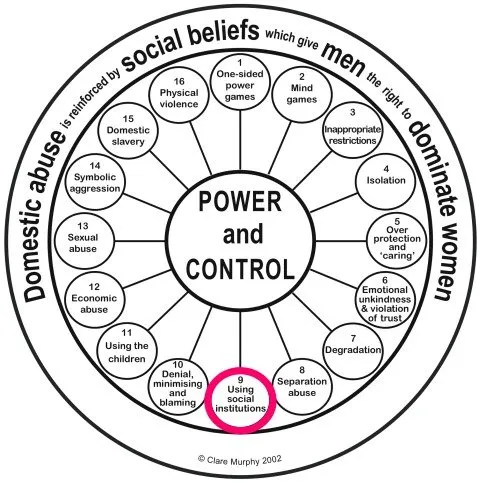
Tactic #9 — Using Social Institutions and Social Prejudices

  – Posted in:Intimate partner abuse, Male perpetrators, Social Institutions & Abuse, Why does he do it
This is the ninth of 16 blogs discussing the patterns of tactics from my power and control wheel – Using Social Institutions and Social Prejudices.
Power & control wheel #9 Clare Murphy PhD
Many perpetrators of psychological abuse use social, health, legal and other institutions such as child protection services as arenas to further their coercive control over their intimate partner.
They use the legal system endlessly to stop their partners from leaving, or to stop them from moving town or country, they do dodgy things to implicate their partner so she will get a criminal record, and perpetrators with financial resources engage women in drawn-out, frequent court battles over property, or over day-to-day care and contact with children. They also use loopholes in the government agency system to avoid paying child support and many use religious ideologies as a tool to keep women and children in line.
Perpetrators who use coercive control also use male privilege and entitlement believing that they “own” their partner, that she must obey and serve them. The good news is that some perpetrators seek help to stop abusing their partner by attending stopping violence programmes. The bad news is that many men then use that programme to further control women. I’ll explain what is meant by all of this below.
Of all the women I interviewed for my Masters research, Adriana had experienced the least amount of psychological abuse. However, it was a different matter after she divorced her husband — he threatened to kill her and began to use social institutions as a vehicle to establish power and control over her.Adriana said, “I think what pisses him off is that I was always in control of my life. The only thing he can get at me with is through our daughter, using the system he can control me.”
How is it possible for perpetrators of psychological abuse to use social institutions to further their coercive control when there may actually be good quality legislations and dedicated well-trained professionals who work hard to protect victims of abuse? Well — there are flaws in the systems — which means some policies, legislations and professional practices can lead to colluding with perpetrators by not holding them accountable for their actions, and can lead to blaming the victims. One of the flaws in the system is a lack of staff training in the dynamics of coercive control in the context of intimate partner abuse. Women I interviewed for my Masters research and men I interviewed for my PhD research tell their stories below….

Using the Legal System to stop women from moving town or country

Adriana regretted moving from  the UK to New Zealand with her partner Steven. His controlling behaviours increased when they arrived back into his home territory. After their separation Steven became abusive in the extreme — he threatened to kill her. For hers, and her daughter’s safety, Adrianawanted to take her daughter back to the UK. However, she could not leave “because he doesn’t want our daughter to leave the country, therefore I can’t leave with her. I wouldn’t leave without her, so I have to be here. I’m quite happy and settled here and doing what I’m doing, but my freedom is totally cut down. I don’t have the freedom to even move towns because he would prevent me. I would have to go to court. It would probably take a year before I could move. He wouldn’t allow me to. It’s the court who would possibly allow me to.”
Heather became pregnant when she was in the process of applying for university. She knew she wanted to leave Luke and pursue an education, so was going to have an abortion. But Luke had High Court papers served on her and the hospital to prevent the abortion. This institutional response fueledLuke’s fire, which enabled him to become even more controlling. Heather wanted to take out a protection order, so that if he breached it, the police would have rights to intervene and arrest him. However, the lawyer insisted she take out an “undertaking” instead. This is one way that the legal system fails to protect victims of intimate partner abuse. An “undertaking” is only a promise — it does not give the police legal rights to arrest a perpetrator of abuse when he breaches his undertaking. The legal system enabled Luketo breach the undertaking. He did this by approaching Heather in the street and also when she dropped her son off at the agency who provided supervised contact. Each timeLuke approached Heather he begged her for more contact with their son, he cried and swore at her. Heather had been wanting to move towns with her son to pursue a new life away from the abuse, but Luke used the legal system to prevent her from doing so.

Using the Legal System to fight for custody of children, with the underlying aim of maintaining power and control over the children’s mother

Elizabeth and David attended a mediation conference where an arrangement was made for Elizabeth to have the children three or four days a week and David would have them for the other three or four days. Such shared care is very disruptive and destabilising for children. Elizabeth said no-one was enjoying it. So Elizabeth “tried to talk to David about ‘What can we do about this? Can we try this, can we try that?’ He wasn’t interested. In the end the kids were really unhappy and she just said, ‘I am just not going to do this any more’ and of course it forced all the legal eagles to get together and deal with it.” David was a wealthy professional so had the financial resources to use the legal system to continue to coercively control his ex-wife.
Elizabeth said, “The judge made the decision which was a much more viable arrangement, which David was really angry about. He still wanted to go to court for custody and of course I am on legal aid. I’ve paid altogether over $25,000 on legal fees, $13,000 I still owe. We worked our guts out to try and get some negotiation before we went to court about custody. He would not respond, he would notnegotiate. As far as he was concerned he was going to get what he wanted and he wasreally pissed off when he didn’t. He said, ‘I paid all this money to get what I wanted and I still haven’t got it.’ He was really angry about that. But I think part of him continuing to push for doing everything legally was because it would cost me a lot of money — money that I don’t have.”

Coercive tactics that lead to the victim getting a criminal record

Elizabeth said David took “up this trespass order when the property settlement came through. A few weeks later I was caught up with my car, and I was going to be late, and he was going to be picking the kids up from my place. I tried to get him at work and tried to get him at home quickly but couldn’t get hold of him. So I rang my neighbour to say, ‘If he turns up can you let him know that I will drop the kids at his place.’ I did what I could to get the message to him. He was absolutelyfurious. So I dropped my kids there and then rang up a bit later to say, ‘I am really sorry about what happened I tried to get hold of you.’ He hung up on me. At that stage I was really angry, because I thought it was important that he and I have some communication because of the children, so I went around to apologise and say, ‘We need to sort something out here, like there are going to be times when one or either of us is not going to be able to meet a time. What are we going to do in that situation? This isn’t going to work.’ But, he called the cops, had me arrested for trespassing. The kids see the cops take me out of what was our home, off in a police car. Anyway I explained the situation to the cops. They said, ‘Don’t worry about it, we’ll go and get your car, we’ll have a word with the guy, I’m sure he doesn’t really want to press charges.’ They came back — ‘Yes he does want to press charges. Don’t worry about it we’ll get diversion, first offence.’ But for diversion the complainant has to agree. He wouldn’t agree to me having a diversion coz he wanted me to have a criminal record. I had about three court appearances, and my lawyer eventually got it to the point where, I think he knew David years ago, and he rang off the record and said, ‘Hey listen mate I wouldn’t do this if I were you.’ Eventually got him to change his mind and I got diversion. But he was prepared to take it to the absolute limit.”
Anthony engaged in tactics that wrongfully led Susan to be investigated and prosecuted for fraud. After Susan separated fromAnthony she did not have a car so he would take her to get the groceries. Her overlocker was not working so Anthony took it into town.Susan said that when he came home he said, “It’s not worth fixing, but they’ll give you so much for a trade-in if you want to buy a new one”. So Susan agreed. Susan told me: “This is how naïve and trusting I was. He brought me home a new overlocker. It was in his name. He put me down as being his spouse. He put my address as being his address. When he got his cell phone he did the same thing. He put me down as being his spouse.”
Unfortunately for Susan the government department that provides financial support to single parents contacted her saying, “’You know you’ve been living with Anthony while you’ve been on the single parent benefit.’ She said they had all this evidence that said I was with him because he’d put me down as being his spouse. I said ‘I wasn’t with him’, but they said, ‘He used to take you to town. You used to drive his car’. I said ‘Yeah, but that doesn’t mean that we’re together.’ Anyway, I didn’t know the overlocker was in his name until the last time we split up and I got done for fraud. I said we weren’t a couple. Anthony was telling everybody that we were a couple. That really hurts. I thought I’d got out from him, but he’s still doing these things to make it look good. I hated him. I hated the things he’d done to us, to the low level that he’d brought us down to.”

Using the Government Agency that provides financial benefits to single parents

After she was divorced, Elizabeth spent some time on the single parent benefit whilst caring for her children. During that time she was having a casual relationship with a man. When parenting of children is shared, it is inevitable that children chat to the other parent about what happens at the other house. However, many perpetrators of coercive control use children to find out information that they then use as ammunition to continue controlling their ex-partner.Elizabeth said one time when her son came to her place to stay he asked her, “How many nights a week does Stewart stay mum?”Elizabeth said, “Next thing there’s an investigation by the fraud squad of [the government agency that provides the benefit].” The fraud squad asked, “We believe you have a partner now, what’s his name, when does he stay here, is it a relationship?”Elizabeth was angry, saying this government agency “would rather that you were f***ing a different guy every night than seeing one person who was giving you a bit of moral support or having sex once every three months.”
Elizabeth said David’s accusations to the department that provided the benefit meant that “To stay on the single parent benefit was a challenge, it’s happened twice. In fact the first time was when I was doing some odd jobs from time to time, helping a friend with her business. Anyway the next thing I’ve got the fraud investigation people. Pretty much all of the work that I was doing I was declaring, and the next thing I’ve got them on my case, ‘Did you do work at this place, did you sell this, do that, dah, dah dah dah dah?’ If I did cleaning jobs the kids used to come with me. They told David and David collated all the information that the kids got and gave to him and sent it to the government agency.”

Using the Government Agency that manages child support payments by separated parents

After couples separate, perpetrators of coercive control often find loopholes in the system and use that gap to pay minimal money towards supporting their children, or they may pay nothing at all. Men I interviewed for my PhD said not all men have a problem with paying child support, but some men do. Some controlling intimate partners do not have the best interests of the children at heart. As James said, many men believe “they’re controlled by a government agency over the kids that maybe they feel they own themselves… It’s a loss of control thing, their own personal property.” Lazarus knew the loopholes in the system. He said, “as soon as they start taking money out of my wages, I quit and change jobs … probably every eight months.” This, meant the system’s policy did not oblige him to pay for a period of time. Children involved in such a climate of control are negatively impacted in various ways, for example, not being able to afford to attend school camps and so miss out on healthy social bonding, physical challenges and may develop anxiety, depression or delinquent behaviour problems.
Some perpetrators of coercive control threaten their ex-partners by telling her that if she pursues child support payments from him, he will use the legal system to push for shared custody of the children which would then mean he would not be obliged to pay child support. This is frightening for women victims of coercive control because most women will do what ever it takes to keep their children safe. In their book, The Batterer as Parent: Addressing the Impact of Domestic Violence on Family Dynamics (SAGE Series on Violence against Women) Lundy Bancroft and Jay Silverman draw from their clinical work with men that shows many perpetrators of intimate partner abuse do not engage in healthy fathering practices and many push for custody or contact with children partly as a tactic of maintaining control over the woman, not because they want to develop a warm relationship with their children.

Using Child Protection Services to coercively threaten the children’s mother

Susan said that, “One time Anthony rang and said that a child protection social worker rang and wanted him to go in. When he came back he said someone’s reported that our daughter’s been sexually molested. He said, ‘It’s your father.’ I found that really odd that they didn’t contact me, that he had to just go in without having a set appointment time and that he could take our son with him. Anyway I said, ‘So you don’t want dad looking after our daughter?’ He said, ‘No that’s alright, but they’re going to contact the kindy’. I was absolutely distraught because my dad has a lot to do with my kids. I fully believed Anthonyknew what he was bloody saying. I went to the kindy and asked if they’d been contacted by the child protection service social workers. They said, ‘No’ and would let me know if they were. When I did talk to the social worker she said, ‘We had an anonymous person whose given the names and ages of the children.’ The ages weren’t right. She said it was a man. She said, ‘We don’t follow up on these ones they’re very low priority’. It pretty much wasAnthony that was doing this, because if there’s an investigation saying that my father’s molesting our daughter, then what happens, the kids get taken away. Of course he fully denies that he’d done it.”
Luckily, in Susan’s case, the child protection services did not remove Susan’s daughter. However, many perpetrators of coercive control threaten their partners saying they will inform child protection services that they are an unfit parent. Unfortunately sometimes the child protection system colludes with perpetrators and engages in mother blaming, partly because of a lack of staff training and understanding of the dynamics of coercive control.

Using Religion to establish and maintain power and control

Some men use religious ideologies to justify controlling their partners, by for example telling her she has to obey him because the Bible says so. They may use religion to stop their partner from leaving by saying that God does not allow divorce. Eva Lundgren (1995) interviewed fundamentalist Christian couples in Scandinavia. One man believed that keeping his wife in line was very important because it meant keeping the “pattern of nature” and meant he was following God’s plan. Part of the men’s aim for using the Bible as a guide was to enforce rigid gender roles for women, so that the more feminine they perceived their partners to be the more masculine this made them feel — a feeling which makes some men feel more strong, secure and superior.

Using Social Prejudices as weapons to degrade and control women

Some perpetrators of psychological abuse use social prejudices to reinforce their power. They may do this by drawing on a range of social hierarchies. Social hierarchies only exist because people decide who is superior and who is inferior. Here’s what I mean….
He may draw on the gender hierarchy that men are more superior than women and tell their partner she deserves abuse because she’s ‘just’ a woman.
He may draw on the race hierarchy that ranks white people as ‘better than’ and tell her she’s ‘just’ a Mäori, or ‘just’ a Black woman, or ‘just’ an Indian/Aborigine/Hispanic, and so forth.
He may draw on the hierarchy that classifies some age groups as having more rights and privileges, saying she’s ‘just’ a kid.
He can find many social messages that place him at the top of any hierarchy related to work and finances.  He may be a breadwinner, earn more money than his partner, have wealth in his extended family, work as a lawyer, etc. — such positions are accompanied with kudos, status, respect and a sense of entitlement. She may engage in activities classified low on the hierarchy such as be a ‘stay at home mum’, do volunteer work, or work in paid employment as a cleaner — such positions tend to afford less respect and can be viewed as inferior…. In these circumstances, some men use their socially superior position to degrade, use and control their partners. They may do this by saying to their partners: “you don’t have any right to make decisions because you don’t have a ‘real’ job”, “you’re ‘only’ a mother”, “you have no money so you’ll get nowhere without me”. Then if a woman is dependent on her partner financially and she leaves him, he may further abuse her by engaging her in repeated and lengthy child custody and property battles, or may refuse to assist her and the children financially. Such unjust degradation can make women vulnerable to ongoing coercive control partly because what their partner tells them makes commonsense, because so many people have not learned to critique socially constructed concepts such as social hierarchies. The idea of equality between spouses flies out the window.
Other social prejudices perpetrators draw from include hierarchies relating to physical and psychological abilities — they may say to a disabled wife: “you will never amount to anything, you can’t even walk out the door”. Or they may use body image as a source of degradation by calling their partner “a fat slob”, and they may call a partner who does not have high level of education “a dumb bitch”. As Victoria points out below, all of these comments reinforce messages that surround all of us all the time.
Whenever Graham made snide remarks aboutVictoria’s size, he’d trivialise the negative impact on Victoria by saying, “Oh but it’s only a term of endearment”. Victoria said “I knew I was big, so it destroyed me a little bit more”. To cope with the abuse Victoria said, “I didn’t try to change my size because my weight is about safety. If I am overweight, I am fat, if I’m fat I’m ugly, if I’m ugly I’m safe, so I eat to keep safe. If you stop eating, you lose weight, people say ‘oh you’re looking good’, then you get abused. I ate because I was hurting. To get over the pain I eat.”
Some women learn that if they challenged their husband’s controlling behaviours, this would cause him to find more and more ways to maintain control by degrading them.

Using Social Prejudices that stigmatise mental illness

In our society, being healthy and well is considered worthy of praise, while having a mental illness and taking medication such as antidepressants is often stigmatised. Some people use these unjust social ideas as weapons to abuse and control others — by attempting to sway how the victim perceives themselves. Perpetrators who are hell